CUSTOMER PERSONA SERIES · PART 2
How to Build a Customer Persona/ Buyer persona: Where the Data Actually Comes From.

In Part 1, we covered what a customer persona actually is, and the 5-step process behind building one: collect data, find the patterns, create the profile, validate it, and put it to work. That’s the framework. But the question most people get stuck on is the very first step — where does this data actually come from?
That’s what this part is about.
Behavioral Data: What People Actually Do
Start with the tools that show you real behavior, not assumptions. Depending on where your business operates, this could include:
- Google Analytics (GA4) and Google Search Console — how people find you and move through your site
- Microsoft Clarity or Hotjar — session recordings and heatmaps showing where attention actually goes
- Amazon Brand Analytics or Shopify Analytics — purchase behavior if you sell through those platforms
- Meta Business Suite and Ads Manager — engagement and audience breakdowns on social
This is the data that fills in your buyer persona’s behavior patterns and demographics — the factual, observable part of the profile.
Direct Feedback: The "Why" Behind the Data.
Analytics tell you what happened. They don’t tell you why. For that, you need to actually talk to people — a short survey (Google Forms or Typeform work fine), a quick call, or even a comment thread. Ask what almost stopped them from buying, and what they’d change.
This is where your buyer persona goals and pain points come from — and it’s usually the part that makes a persona feel like a real person instead of a spreadsheet row.
Market Research: Filling the Gaps.
Beyond your own data, broader market research rounds out the picture:
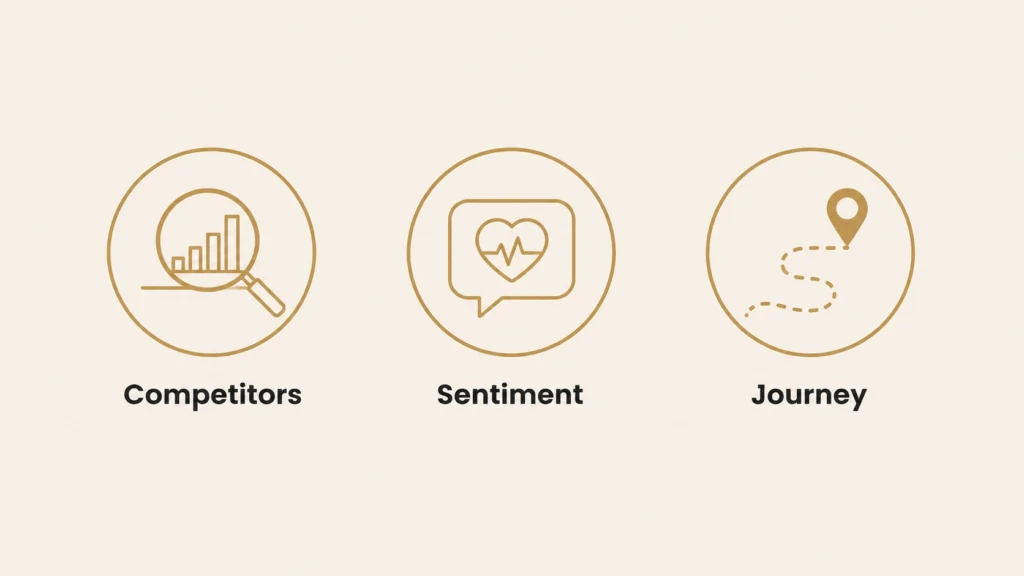
- Competitor offerings — what they promote and how, which tells you who they’ve already identified as valuable
- Customer sentiment — what people are saying publicly, in reviews or comments, about problems like the one you solve
- Customer journey mapping — the path someone typically takes from noticing a problem to buying a solution
This research helps humanize your buyer persona further, and it’s especially useful if your own customer data is still thin.
Turning Raw Data Into One Clear Pattern.
Once you’ve gathered data from these sources, the real work is spotting what repeats. Look across your behavioral data, feedback, and research for the traits, interests, and pain points that show up again and again. Those repeating patterns — not the outliers — are what belong in your persona.
Validating What You've Built.
Before you treat your buyer persona as final, test it. Share it with your team and see if it matches what they’re seeing on the ground. If you can, take it back to a few real customers and ask if it actually sounds like them. A persona that hasn’t been checked against real people is still just a guess with a name attached.
Putting the Data to Work
Once your persona is validated, share it beyond marketing — your product team and promotion team benefit from the same profile, since it helps everyone build and communicate around the same real person. This is also where things like AI-driven personalization become genuinely useful: once you understand a customer’s past behavior and preferences, you can use that data to shape more relevant product recommendations and messaging, rather than sending the same message to everyone.
One practical filter worth applying here: figure out which channel your persona actually spends time on before you try to reach them. A younger, trend-driven audience is usually easiest to reach on Instagram or TikTok, while a B2B audience responds better to LinkedIn and email. Knowing this in advance saves a lot of wasted effort.

What Comes Next
You now know where the data comes from and how to turn it into something usable. In the next part, we’ll put all of this together into a complete, real example — plus a template you can copy directly for your own business.